
On Reparation, Healing, and Harmony : What “Princess Mononoke” Can Teach Us About Surviving the Climate Crisis
BY JUSTINE VANDENBERG
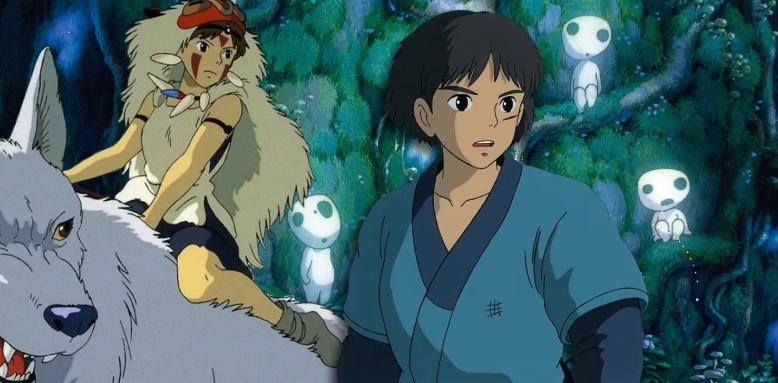
Princess Mononoke, affectionally called “San” (left) and Prince Ashitaka (right) in Hayao Miyazaki’s “Princess Mononoke” (1997). © Studio Ghibli / Sourced from CBR
A wild wolf princess and an outcast warrior prince? Say no more. For most, the image of the blood-stained wolf girl and the archer prince atop his noble elk has become an iconic symbol of beloved animated classic “Princess Mononoke.” Directed by Hayao Miyazaki, the anime is a classic Studio Ghibli story complete with the idiosyncratic characters, complex themes, piercing soundscapes and deep philosophical undertones that the Japanese animation studio is known for.
However, “Princess Mononoke” is unique in its focal exploration of environmentalism. Studio Ghibli fans have described it as notably distinct from other Ghibli films in its particularly serious tone, occasionally uncomfortable gory visual symbolism and unflinching refusal to water down the reality of violence. In a modern moment defined by global ecological degradation, climate disruption, species extinctions and pervasive suffering on behalf of both human and natural communities, the film’s timeless themes have only continually become more relevant. At a time when the 21st century begs the question of how we can restore a broken relationship with our earth, “Princess Mononoke” gives us some profound insight.
Released in Japan in 1997 and then again in 1999 in the U.S., Miyazaki’s masterpiece reflects a keen commentary on the evolution of human societies, observing that so-called human and technological “progress” is often dependent upon ecological plunder and therefore accompanied by immense avarice, violence and suffering to both ecological and human communities alike. Throughout a convoluted and intense 2 hours and 13 minutes of scenescapes that alter between breathtaking and disturbing, peaceful and brutal, the film explores the reciprocal and complex relationships over time between humans, land and animals.
Directly inspired by environmentalist and feminist theory, Miyazaki’s blend of historical fantasy with an all-too-familiar cautionary tale earned its position as the highest grossing film in Japan upon its release and has remained the sixth highest-grossing Japanese film of all time to this day. In the decades following its initial release, the anime has grown to be a critically acclaimed success across the world.
So what exactly is it that makes “Princess Mononoke”pierce with such timeless resonance? At its core, the classic is a meditation on reparation, harmony and healing. The film opens by establishing a time-honored and balanced relationship that traditionally existed between mountains, forest, animals and humanity. We, the audience, get a glimpse at what such a relationship could look like through the opening backstory of protagonist Prince Ashitaka. Prince of the Emishi tribe, an ancient Indigenous people thought to be extinct by other westward human societies later in the film, Ashitaka’s people live in close proximity to the land, harvesting only what they need for their simple but sophisticated village and performing spiritual acknowledgement rites to the earth when an exchange of life or harvest takes place.
However, the film finds its inciting central conflict in a widespread severance of this sacred relationship between humanity and nature at large in a distant city called Iron Town, where the burgeoning city’s rapid extraction of iron ore advances its innovations in mechanical weaponry and newly-innovated guns. Led by the fearless and cunning Lady Eboshi, Iron Town’s heedless iron extraction comes at the expense of desecrating the mountains and forests, wiping out the natural homes and populations of wild animals in the process. This injustice—first perpetuated by the humans—and corruption of the mutualistic reciprocity that existed between humans and nature causes the spirits and animal gods of the forest to transform from entities of peace and wisdom into beasts of rage and vengeance.
It is one of these beasts—a boar “cursed” by an iron bullet found wedged in its heart—that attacks the Emishi people in an unnatural assault of blind rage and intentional violence. In defense of his people, Prince Ashitaka kills the boar, but not before the curse of its rage—visualized by swarming black worms—infects a wound on his own arm from the fight, inflicting the curse upon Ashitaka himself. The village medicine woman tells Ashitaka that the curse will likely spread and kill him, and that he cannot “alter his fate,” but that he can “choose to meet it.”
Giving him instructions to find the source of the harm perpetrated by the iron bullet that infected the boar and most importantly, to “see with eyes unclouded by hate,” Prince Ashitaka is outcast from his village to begin his mission westward, riding his trustworthy steed and steadfast companion, red elk Yakul.
Though he attempts to keep a low profile, Prince Ashitaka’s path soon crosses with many memorable characters from all walks of life, including a cynical and greedy monk, simpleminded warriors from Iron Town whose lives he selflessly saves, the hardworking and bold women of Iron Town who gladly bear the hard brunt of industrial labor as a preferred alternative to prostitution, and the cunning Lady Eboshi, leader of Iron Town.
Lady Eboshi, Ashitaka eventually learns, will stop at nothing to keep plundering the forest to fortify her rapidly growing town with her newly formed weapons, hellbent on a personal vendetta to kill “the wolf girl” and take the head of the Nightwalker, the mysterious Forest God whose breath is said to both give life and take it away and whose guidance oversees the balance of life across Earth. After a failed attempt to get Lady Eboshi to reconsider her mission fueled by greed and hate and to stop harming the forest and its animal companions, Prince Ashitaka finds himself in allyship with the fierce and feared wolf princess herself, “Princess Mononoke”—more affectionately called San.
Prince Ashitaka learns that San, filled with grief and indignation at the desecration of the forest and the slaughter of its animals who raised her as an abandoned child that was discarded by her human parents, has let her righteous rage fuel her own blind vengeance, and she, too, will stop at nothing to kill Lady Eboshi and put an end to Iron Town’s destruction. Faced with this symbolic and deeply severed relationship between nature—represented by San—and progressing human society—symbolized by Lady Eboshi and Iron Town—Ashitaka himself is left in the middle. Repeatedly throughout the film, Ashitaka is asked to pick a side: Eboshi or San, humans or nature.
However, while Ashitaka attributes the source of the wound to Iron Town’s condemnable actions, and while his heart lies with San and his allegiance to the Nightwalker, Ashitaka ultimately resolutely refuses to pick one side or the other.
Instead, true to his vow to “see with eyes unclouded by hate,” Ashitaka sees a way forward in which a flourishing planet can include both humanity and nature, living in mutualistic harmony. This recurring thematic decision challenges polarized simplifications in which humanity is all only “destructive” and nature is all only “good,” leaving room for the value of nuance.
Most importantly, Ashitaka’s choice teaches us something that is crucial to our own quest to build a more sustainable future moving forward. We must remember that humans are not separate from nature. Rather, we are an important part of nature ourselves, and there are plenty of ways for human society to flourish in mutualistic harmony between the land, its resources and animals while avoiding the suffering and violence of avarice.
But how to redress the wrongs that have been committed, and how to repair the broken relationship between humanity and our earth that has been severed by our own species’ greed? The answer may lie in the movie’s most iconic scene, which U.S. theaters controversially requested Miyazaki to cut.
Miyazaki and producer Toshio Suzuki ardently refused to, stating that the scene encapsulated the most fundamental theme of the film and famously sending back a reply in the form of a katana with the words “No cuts” affixed to the blade.
In said famous scene at the height of the movie’s climax when everything has gone horribly wrong—the Nightwalker killed, the greed of humanity triumphant, and the suffering of violence running rampant—San lashes out at Ashitaka in her despair, appearing to unintentionally and unconsciously harm him in her reactionary grief. Ashitaka, rather than retaliating, just embraces her instead, acknowledging her pain and giving her the shelter of compassion and love to find refuge in.
In this way, Miyazaki’s most central theme comes full circle. His film argues that division and hatred in the face of violence or injustice—even if justified in the first place—will only perpetuate the cycle of violence and harm, and that reparation begins with acknowledgement and accountability, yes, but also forgiveness. Compassion. And love, most of all.
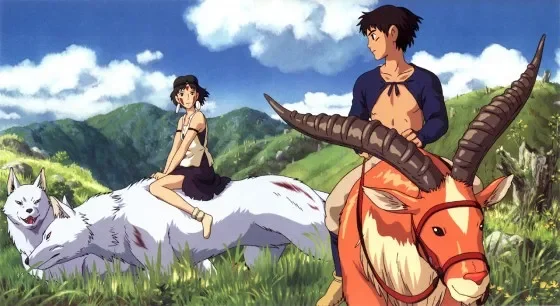
Main characters San and Prince Ashitaka at the film’s hopeful conclusion. © Studio Ghibli / Sourced from Google Images.
By the film’s conclusion, even after apocalypse seems almost certain, Ashitaka and San manage to bring the world back from the brink of death through a symbolic act of reparation to the Nightwalker, which they only accomplish by setting aside their differences and working together in solidarity. Despite the irrevocable harm and discernible lingering impacts of human destruction to the earth that remain after the near apocalypse, the film’s ending is memorably hopeful.
Lady Eboshi realizes the homicidal folly of her ways, acknowledging the wisdom to Ashitaka’s approach and worldview. She vows to build back a new town, and to “do it better” this time. Similarly, we ourselves can realize that it is never too late to make beneficial changes, and that hope always exists as long as people are willing to move forward in radical bravery and love.
In 2026,“Princess Mononoke” has recently received a resurgence in popular attention after Oscar winner for Best Actor Michael B. Jordan memorably mentioned the film at the Oscars, immediately replying when asked what his favorite movie was, “Oh man, I’m going to have to say ‘Princess Mononoke.’”
At a recent showing in late March of the classic at DePauw University for an environmental film night hosted by the Ullem Campus Farm, students came to a collective agreement that they remembered seeing the film as a child and being intrigued by the wolf princess and rogue prince warrior, but now, watching it as growing leaders of the 21st century, the story hit with a level of “gravity” and piercing memorability that was lost on their younger selves.
One anonymous student expressed that “Now, as an environmentalist, watching this again is like woah—that hits much more strongly now.”
Another Sustainability Council student leader also remarked, “‘Princess Mononoke’ has always been one of my favorites, and every time I watch it, the more thought-provoking I find it.”
Admittedly, “Princess Mononoke” may not be for everyone with its niche taste in animation style, often graphic display of gory symbolism, long runtime and complex thematic arc. However, in a global moment when change is crucial, reparation necessary and healing desperately needed, watching “Princess Mononoke”—either again or for the first time—would do us all good. Like Ashitaka, in the face of an existential and overwhelming climate crisis, we must ultimately remember to “see with eyes unclouded by hate.”
The movie can be found on a variety of streaming platforms including HBO Max, Hulu, and Amazon Prime. You can watch the trailer in English here.